
YWS Bearing | Shandong Yuki Bearing
Let YUKI Quality Turning the World.
86-0531-85556568
yuki@ywsbearing.com
yuki@ywsbearing.com
- All
- Product Name
- Product Keyword
- Product Model
- Product Summary
- Product Description
- Multi Field Search
Views: 0 Author: YWS Bearing Editorial Team Publish Time: 2026-11-09 Origin: SKF Bearing Maintenance Handbook; YWS product listing examples
Quick answer: Identify a bearing by first recording its construction and every marking, then measuring the bore (d), outside diameter (D), and the correct width, height, or other axial dimension for that bearing type. Clear photos of both faces and the side profile help. Dimensions can narrow the candidates; they do not prove the exact internal design, rating, material, precision, or interchangeability.
Photograph both ring faces, the side profile, package label, seals or shields, grooves, flanges and any unusual bore. Transcribe characters exactly, including prefixes, suffixes, hyphens, spaces and slashes. A partial marking on one ring may not describe the complete bearing. Identify whether the part is radial, thrust, tapered, flanged, housed, or another construction before choosing its dimensions.
Dimension | Typical description | What to report |
|---|---|---|
d | Bore/inside diameter | Measured value, unit, and cylindrical or tapered bore |
D | Outer-ring outside diameter | Value and unit; note a flange or non-circular outline separately |
B, C or T | Axial width used for the identified bearing type | Name the dimension; do not assume every bearing uses B |
H | Height for applicable thrust forms | Identify the bearing type and measurement faces |
Use a suitable measuring instrument without pressing against a seal or changing the part. Record displayed resolution and units; take readings at more than one position where practical. If the bearing is damaged, corroded or distorted, label the dimensions approximate and provide the original equipment drawing or machine model.
Shield or seal on one or both sides, and any visible contact or clearance features.
Snap-ring groove, flange, eccentric collar, extended inner ring or locking feature.
Tapered bore, split construction, lubrication hole or non-standard outline.
For housed units, identify the insert bearing and housing separately; mounting dimensions are not the same as bearing d/D/B.
Operating load, speed, temperature, contamination, lubrication and shaft/housing fits.
These are actual YWS product listing photos included only to illustrate how a catalogued product page presents a bearing. They do not identify an unknown part or prove that it is a match. Compare your own markings, dimensions and drawing with the exact offered specification.
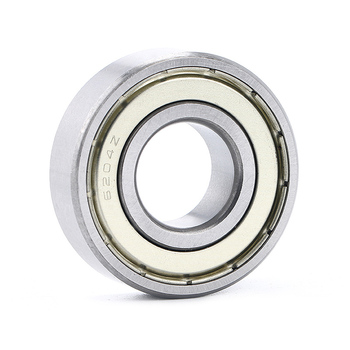
YWS 6204-ZZ product listing — an example catalogued model, not an identification of a buyer's bearing.
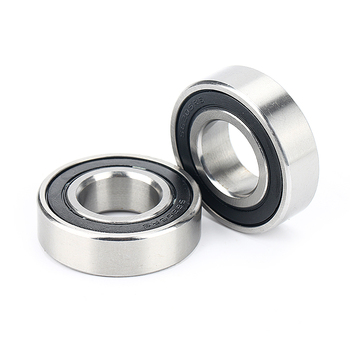
YWS 6205RS product listing — verify the full designation and dimensions; appearance alone is insufficient.
More than one design or suffix can share nominal boundary dimensions. A dimensional search can suggest possible basic designations, but further confirmation may be needed for internal design, cage, clearance, precision, material, seals, lubrication, ratings and application suitability. Ask for the exact offered drawing and identify any differences before approving a substitute.
No. Record its type, all relevant dimensions, markings, seals, and visible features. Outside diameter alone cannot establish a complete designation.
Measure the applicable dimensions for the identified construction and provide photos, secondary features, assembly details and any equipment drawing. Treat catalogue matches as a shortlist until the offered specification is confirmed.
No. They do not establish internal design, clearance, precision, materials, ratings, fits, seals or suitability for the operating conditions.
Send exact marking transcription, photos of both faces and side profile, d/D/width or height with units, secondary dimensions, quantity, operating context and destination. The YWS bearing quotation checklist helps organize an RFQ. For seal terminology, see ZZ vs 2RS bearing buying considerations. Contact YWS Bearing / Request a Quote with your evidence and ask for the exact proposed designation and drawing.
SKF Bearing Maintenance Handbook, “Bearing identification”: identify bearing type, measure bore and outside diameter, then record the applicable width or height; use dimensions to find possible basic designations and review other features. SKF handbook (PDF). SKF is cited for general identification guidance only; no affiliation or authorization is implied.
Prepared by YWS Bearing Editorial Team. Sources reviewed 3 November 2026. This guide supports preliminary identification; final replacement approval requires comparison of the complete offered specification against the application.